3 min read
BeaconChess vs DecodeChess
A position report, or a decision you can rehearse?
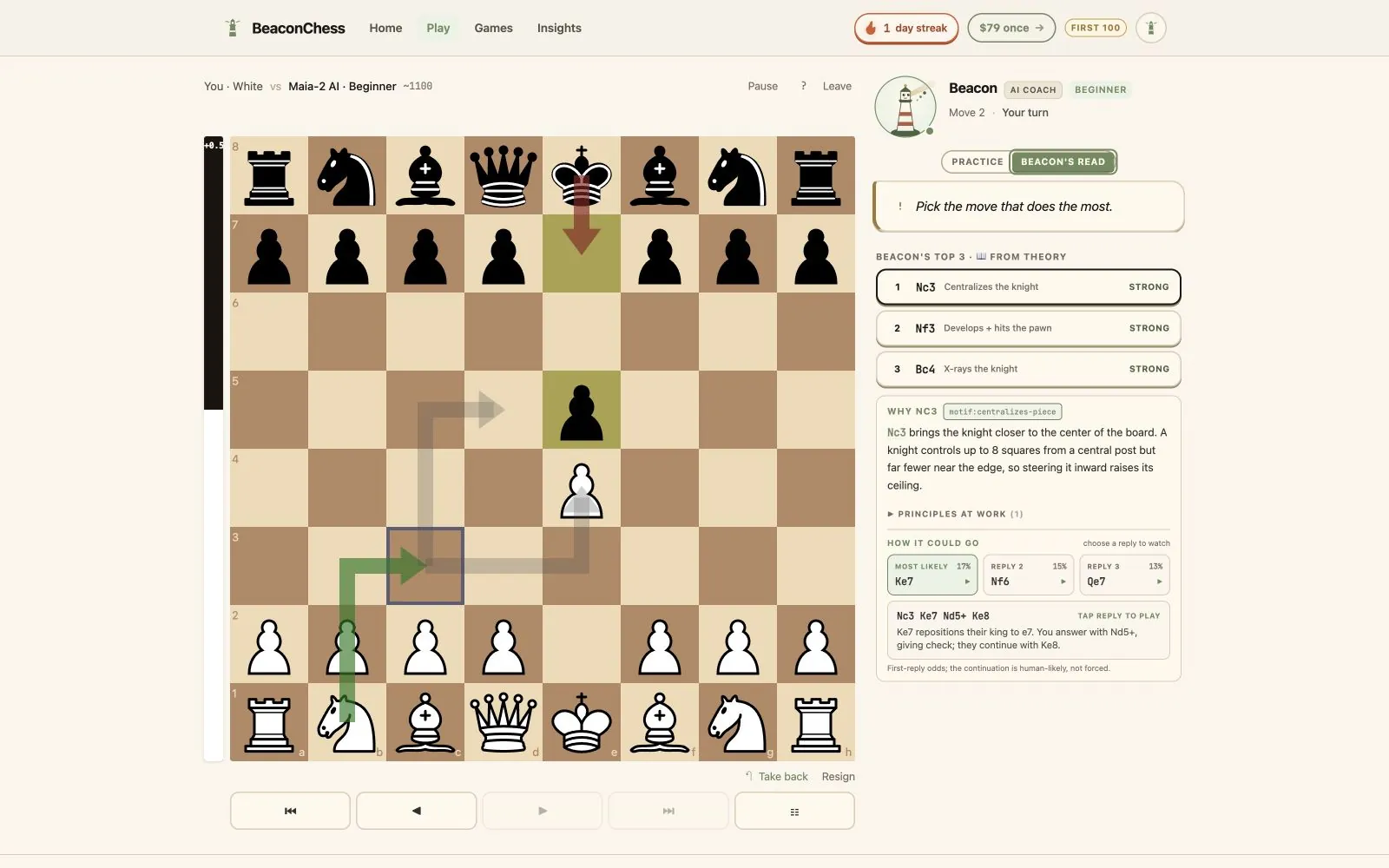
DecodeChess and BeaconChess start from the same frustration: an engine number is not a lesson. DecodeChess gives you a broad conceptual breakdown of the position. BeaconChess stays closer to the move in front of you: choose a candidate, understand its job, and watch how a human opponent may answer.
Both explain the engine
Both products translate engine analysis into language intended to help a human understand what is happening.
Different depth of view
DecodeChess presents a broad conceptual framework; BeaconChess emphasizes the candidate choice and its playable continuations.
Different way to practice
BeaconChess pairs the explanation layer with Maia-2 opponents and can react to decisions inside the same practice game.
On this page
At a glance
BeaconChess and DecodeChess at a glance
DecodeChess publishes a rich feature set, including explanations, threats, plans, piece functionality, a computer opponent, and game overviews. BeaconChess packages a smaller set around a live, visual coaching loop.
Core explanation
BeaconChess
Short, board-specific coaching tied to candidate moves, threats, and likely replies.
DecodeChess
Rich engine explanations organized around concepts and an Idea-Problem-Solution framework.
Candidate moves
BeaconChess
Up to three human-plausible candidates, each scored for chess quality and given a specific “why.”
DecodeChess
Good moves and attacking plans are presented in descending order.
Continuation view
BeaconChess
Tap candidates and replies to play multiple human-likely branches on the board.
DecodeChess
Before-and-after views help show how a recommended move responds to threats.
Opponent model
BeaconChess
Maia-2 human-move prediction across ten labeled levels from ~1100 to ~2000.
DecodeChess
A human-like computer opponent that adapts to the player is part of the published feature set.
Processing and storage
BeaconChess
Stockfish and Maia run in the browser; games and progress stay on the device.
DecodeChess
Use the current DecodeChess privacy and product pages for its latest processing and storage details.
Payment model
BeaconChess
One personal-license payment with no automatic renewal.
DecodeChess
Use DecodeChess’s current pricing page for its available plans and limits.
| Compare | BeaconChess | DecodeChess |
|---|---|---|
| Core explanation | Short, board-specific coaching tied to candidate moves, threats, and likely replies. | Rich engine explanations organized around concepts and an Idea-Problem-Solution framework. |
| Candidate moves | Up to three human-plausible candidates, each scored for chess quality and given a specific “why.” | Good moves and attacking plans are presented in descending order. |
| Continuation view | Tap candidates and replies to play multiple human-likely branches on the board. | Before-and-after views help show how a recommended move responds to threats. |
| Opponent model | Maia-2 human-move prediction across ten labeled levels from ~1100 to ~2000. | A human-like computer opponent that adapts to the player is part of the published feature set. |
| Processing and storage | Stockfish and Maia run in the browser; games and progress stay on the device. | Use the current DecodeChess privacy and product pages for its latest processing and storage details. |
| Payment model | One personal-license payment with no automatic renewal. | Use DecodeChess’s current pricing page for its available plans and limits. |
What DecodeChess is especially good at
DecodeChess has a wide vocabulary for explaining a position. Its published features include threats, plans, concepts, piece functionality, game graphs, and an Idea-Problem-Solution method. That breadth suits players who enjoy examining one position from several conceptual angles.
It also supports analysis while playing against its computer opponent, so “static report” would be an unfair description. Its strength is the amount of positional context it can organize around one board.
- You want a conceptual inventoryInspect threats, plans, piece functions, and positional ideas around the same position.
- You enjoy report-style studyRead the position from several angles before deciding which lesson matters most.
- You like a named frameworkUse Idea-Problem-Solution as a consistent structure for interpreting positions.
What BeaconChess deliberately makes more concrete
Beacon starts from the decision in front of you. Instead of presenting one absolute line, it surfaces several moves a strong human could realistically consider. Each candidate gets an explanation based on the actual pieces, squares, tactics, and pawn structure in that position.
Then the board becomes the explanation. Select a candidate, choose a likely reply, and watch the continuation. That makes it easier to compare “what if they take?” with “what if they defend?” without holding every branch in your head.
- Choice before calculationGenerate a small candidate set before calculating deeper.
- Probable replies, not a single prophecyExplore multiple likely first replies rather than treating one principal variation as forced.
- The same language during playPractice the thinking process against human-shaped Maia-2 mistakes.
How to decide without overthinking it
Use the same PGN in both products and pick one position where the engine recommendation felt mysterious. Give each tool ten focused minutes. Then close both and explain the position aloud from memory.
Choose the product that improves your next question at the board. Feature counts matter less than whether the lesson survives after the interface disappears.
Common questions
Clear answers before you try it.
Is BeaconChess affiliated with DecodeChess?
No. BeaconChess is independent and is not affiliated with, endorsed by, or sponsored by DecodeChess.
Do both products explain engine moves?
Yes, but the interfaces and learning frameworks differ. DecodeChess publishes a broad conceptual analysis system; BeaconChess centers on concise candidate reasons and clickable reply lines.
Who is BeaconChess built for?
BeaconChess is most useful for improving players who want help deciding what to consider, seeing tactical ideas, and connecting an engine line to the actual board.
Test the learning loop on your own position.
Try one coached game and see whether candidate moves plus playable replies make the engine idea easier to retain.