5 min read
Choose the tool for the question
The best analysis tool is the one that closes your gap.
Chess analysis tools answer different questions. One finds the tactical truth, another organizes a finished game, another describes the position, and another helps you rehearse a decision. Choosing by logo is less useful than choosing by the gap between what the engine knows and what you need to learn.
Engine laboratory
Best for deep variation work, evaluation checks, opening exploration, and testing a precise tactical question.
Game-review workflow
Best for quickly finding inaccuracies, blunders, turning points, accuracy, and retry moments in a finished game.
Explanation and rehearsal
Best for connecting candidates and likely replies to the pieces, squares, and patterns you should notice next time.
On this page
Start with the question you are trying to answer
“Analyze my game” can mean several things. You may want to locate the biggest mistake, understand why a natural move fails, explore an opening branch, test whether a sacrifice works, or build a habit that prevents the same miss. Each task favors a different interface.
Write the question before opening the tool. That single step prevents a review from becoming aimless clicking through the top engine line.
- Where did the game turn?Use a game review or full-game computer analysis to identify the positions worth inspecting.
- Does this tactic work?Use an analysis board with sufficient depth and compare the defender's strongest resources.
- Why is this move better?Use candidate comparison, explanatory text, and a visible continuation tied to the board.
- How do I remember it?Turn the line into one board cue, then rehearse a similar decision without the answer visible.
Analysis boards: maximum freedom, minimum hand-holding
A strong analysis board gives you engine evaluation, move suggestions, variations, board editing, opening information, and room to test your own ideas. Lichess is a prominent free example and also supports studies and computer analysis of finished games.
The freedom is valuable when you know the question. It can be overwhelming when the real problem is deciding which variation matters or translating a numerical preference into a reusable lesson.
Game reviews: fast triage after the result
A game-review workflow classifies moves, summarizes accuracy, surfaces turning points, and often lets you retry mistakes. It is efficient because the product decides where to direct attention.
The tradeoff is that a label such as mistake or blunder may still leave the central question unanswered: what did the move allow, which reply punishes it, and what should enter your candidate list next time? Use the review to find the moment, then investigate that decision.
Conceptual explainers: a wider report on the position
Conceptual tools try to describe plans, threats, piece roles, and structural features rather than showing only an evaluation and principal variation. They can be helpful when you understand the tactics but cannot explain what either side should improve.
Check whether the explanation is specific enough to falsify. A useful statement names the relevant piece, square, line, or pawn break. A generic principle may sound educational while remaining disconnected from the position.
Candidate-move coaches: the decision is the unit of study
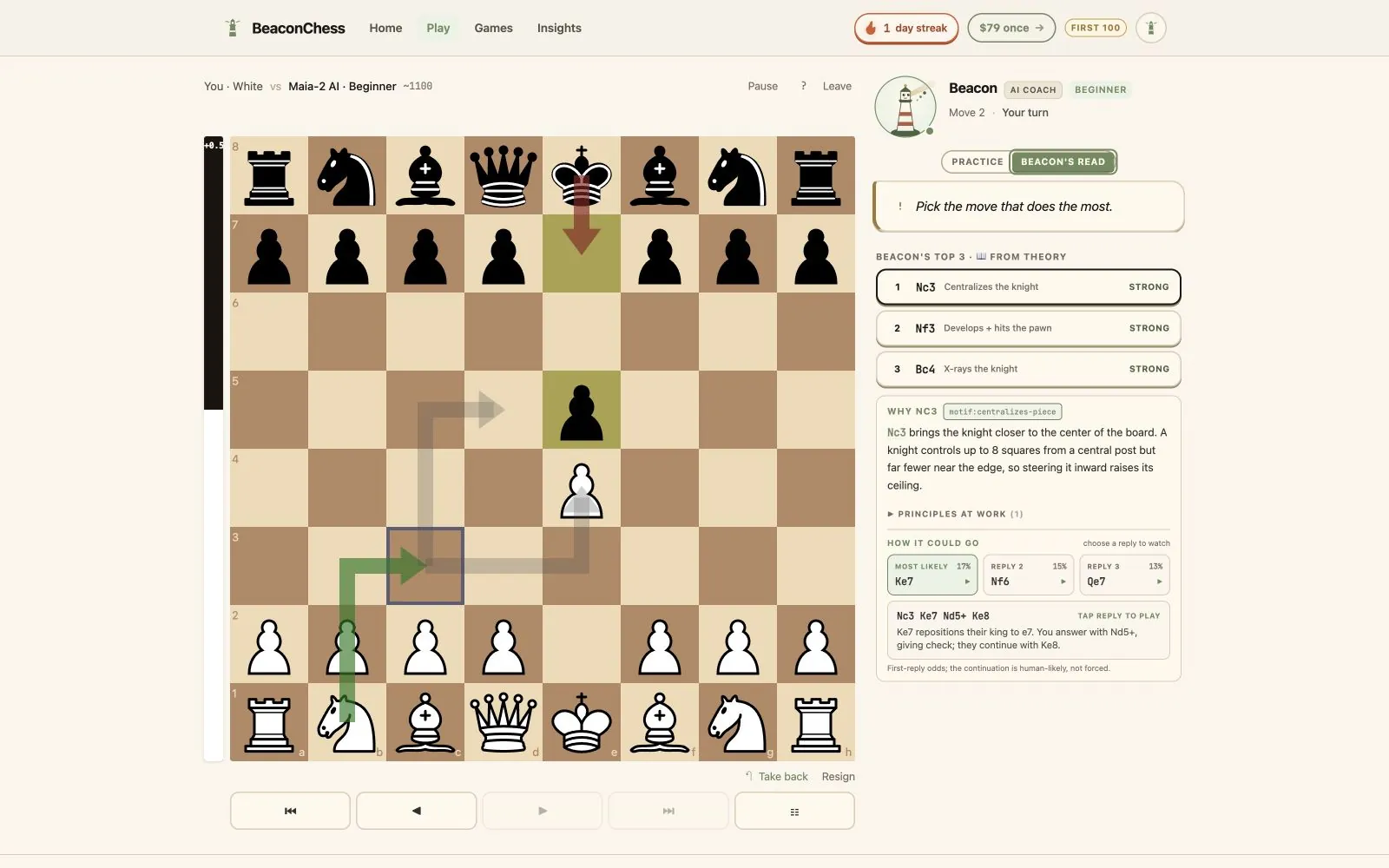
A candidate-move tool asks you to compare a small set of plausible choices. The useful version shows the purpose of each move, the opponent's likely or strongest reply, and the continuation on the same board. This models the process a player can reuse during a game.
Human-move models such as Maia-2 can help identify plausible continuations, while an engine such as Stockfish checks tactical soundness. These roles are different: a likely human reply is not necessarily the engine's best defense, and an engine line is not necessarily the reply a person is most likely to choose.
A checklist for choosing a chess analysis tool
Try the product on one of your own confusing games. Check whether it identifies the right position, explains the actual tactical or positional reason, shows enough of the reply to verify the claim, and lets you leave with a smaller decision rule.
Also consider workflow and boundaries: how games are imported, where data is stored, whether an account is required, what happens without a subscription, and whether the interface encourages legal post-game study rather than assistance during rated play.
- SpecificityDoes the explanation name the pieces, squares, and reply that make the claim true?
- VerifiabilityCan you play the continuation and see why the alternative succeeds or fails?
- TransferCan the lesson be reduced to a cue you might recognize in another game?
- FrictionWill you actually import, review, and revisit games often enough for the workflow to matter?
Common questions
Clear answers before you try it.
What is the best free chess analysis tool?
Lichess offers a powerful free analysis board and finished-game computer analysis. The best choice still depends on whether you need deep exploration, fast game review, or an explanation workflow.
Can a chess engine explain why a move is bad?
An engine supplies evaluations and concrete lines. An explanation layer must connect that evidence to the board feature and decision that a player can understand and reuse.
Should I use more than one chess analysis tool?
Often, yes. One tool can locate the turning point while another helps compare candidates or organize the lesson. Use the smallest combination that answers your actual question.
Are likely human replies the same as best engine replies?
No. A human-move model estimates what people may choose, while a chess engine searches for strong play. A useful analysis interface labels that distinction clearly.
Test the explanation on one real decision.
Play the free coached game or paste a PGN and compare the candidate moves, reasons, and likely replies on the board.