3 min read
BeaconChess vs Lichess analysis
Explore every line, or get help finding the line that matters?
Lichess gives you a powerful free laboratory: engine evaluation, variations, opening data, studies, and mistake review. BeaconChess solves a narrower problem. When the analysis tree feels endless, it helps you choose what deserves attention and turns that choice into a short, visual lesson.
Explore without limits
Lichess offers an analysis board, engine evaluation, move suggestions, mistake review, opening information, and studies.
Know where to look
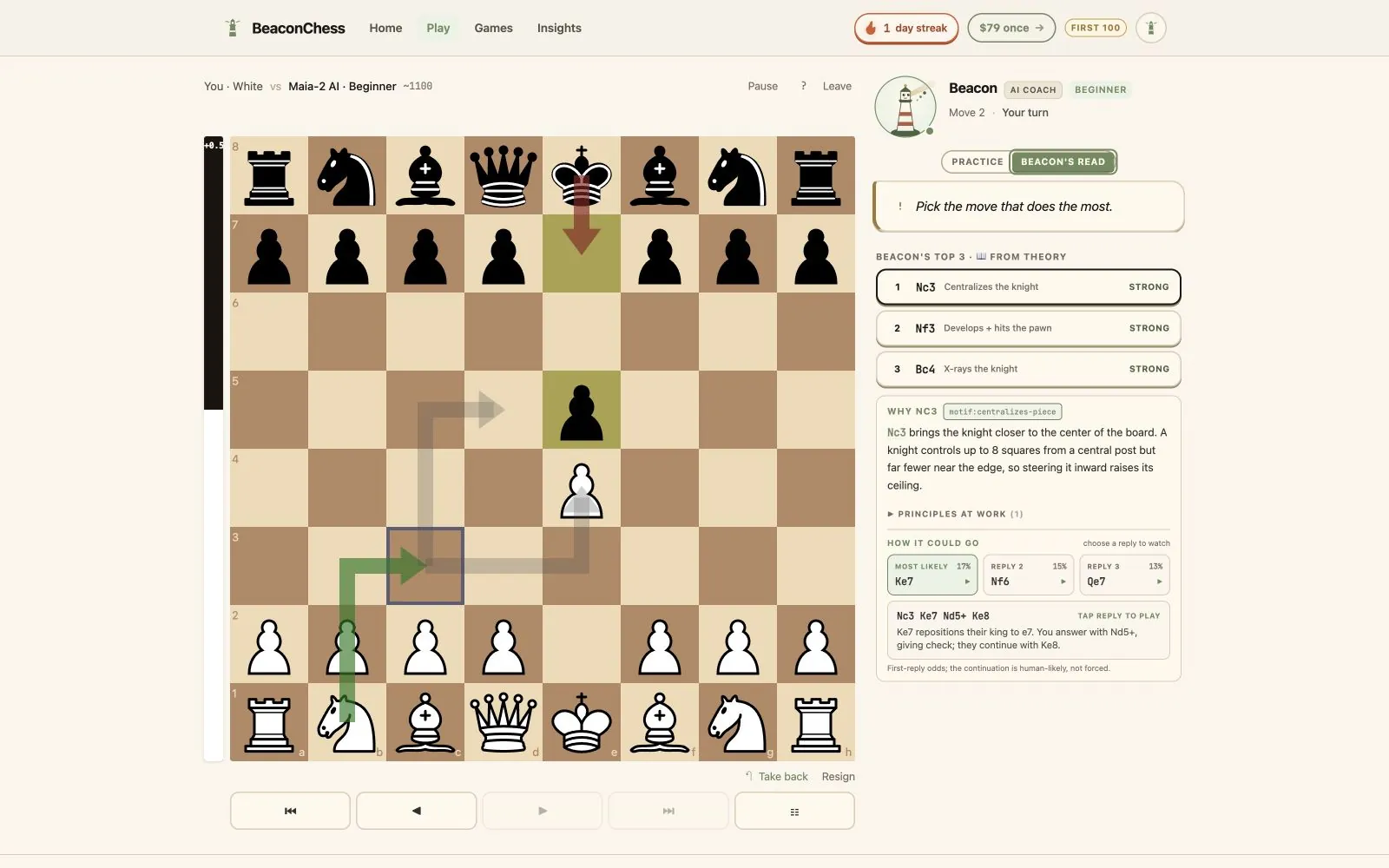
BeaconChess turns key positions into candidate choices, board arrows, concise reasons, and likely reply branches.
Move between both
Paste any Lichess PGN, or connect Lichess after unlocking to select recent games without copying and pasting.
On this page
At a glance
BeaconChess and Lichess analysis at a glance
Lichess is the stronger choice for broad, free analysis infrastructure. BeaconChess is the more specialized choice for explanation-first coaching.
Primary workflow
BeaconChess
Guided coaching during a game and an explanation-led recap afterward.
Lichess analysis
Open analysis board, computer analysis, studies, and interactive mistake review.
Engine output
BeaconChess
Uses Stockfish quality plus chess-specific rules to turn lines into board-specific prose.
Lichess analysis
Shows engine evaluation, best moves, inaccuracies, mistakes, blunders, and analysis lines.
Candidate comparison
BeaconChess
Shows several plausible choices with a “why” and likely reply branches.
Lichess analysis
Lets the player explore variations freely and inspect engine suggestions.
Practice opponents
BeaconChess
Ten Maia-2 levels designed around human move likelihood.
Lichess analysis
Offers computer play as part of the wider Lichess platform.
Game import
BeaconChess
Manual PGN for anyone; recent-game Lichess connection after unlocking.
Lichess analysis
Games played on Lichess are already available in the player’s account and analysis tools.
Price
BeaconChess
Free first coached game and three PGN analyses, then a pay-once personal license.
Lichess analysis
Lichess is free and supported by donations.
| Compare | BeaconChess | Lichess analysis |
|---|---|---|
| Primary workflow | Guided coaching during a game and an explanation-led recap afterward. | Open analysis board, computer analysis, studies, and interactive mistake review. |
| Engine output | Uses Stockfish quality plus chess-specific rules to turn lines into board-specific prose. | Shows engine evaluation, best moves, inaccuracies, mistakes, blunders, and analysis lines. |
| Candidate comparison | Shows several plausible choices with a “why” and likely reply branches. | Lets the player explore variations freely and inspect engine suggestions. |
| Practice opponents | Ten Maia-2 levels designed around human move likelihood. | Offers computer play as part of the wider Lichess platform. |
| Game import | Manual PGN for anyone; recent-game Lichess connection after unlocking. | Games played on Lichess are already available in the player’s account and analysis tools. |
| Price | Free first coached game and three PGN analyses, then a pay-once personal license. | Lichess is free and supported by donations. |
Why Lichess analysis is hard to beat for exploration
Lichess gives players an unusually capable free workspace. You can inspect engine evaluations, move suggestions, full variations, opening information, computer analysis, and studies. “Learn from your mistakes” also turns selected errors into an interactive exercise.
For a player who already knows how to interrogate an engine, build variations, and annotate a study, that freedom is a major strength. The analysis board does not decide how deeply you should investigate; it gives you room to follow the questions you already know how to ask.
- You want the full variation treeFollow sidelines freely instead of staying inside a guided review sequence.
- You build your own studiesSave positions, annotations, chapters, and recurring themes in one flexible workspace.
- You already know the questionUse the engine and board to investigate a tactical or positional idea in depth.
Why some players still want a coach layer
An analysis board can answer almost any question, but the player still has to ask the question. Beginners and many club players get stuck at the same point: the engine says a move is better, yet the board still looks like a collection of unrelated pieces.
Beacon narrows the field. It identifies a small candidate set, explains the point of each move in the current position, and lets the player watch likely replies. The goal is not more engine output. It is a better next thought.
- Use Lichess for the laboratoryBuild studies, test sidelines, and inspect the full engine tree.
- Use Beacon for the lessonTurn a confusing position into a few moves and concrete reasons.
- Move games between themPGN keeps the workflow portable instead of locking study to one site.
A simple combined workflow
Play where you already play. Use Lichess analysis when you want to investigate freely. Bring the PGN to BeaconChess when you want the candidate decision and likely human replies explained in a more guided way.
If the same mistake repeats, return to Lichess and build a small study around that motif. One tool helps you discover the lesson; the other gives you room to expand it.
Common questions
Clear answers before you try it.
Is BeaconChess affiliated with Lichess?
No. BeaconChess is independent and is not affiliated with, endorsed by, or sponsored by Lichess.
Can Lichess games be analyzed in BeaconChess?
Yes. Anyone can paste a Lichess PGN. After unlocking, a Lichess connection can load recent games without copying and pasting PGNs.
Why pay for BeaconChess if Lichess analysis is free?
Pay for BeaconChess only if its explanation layer, candidate choices, visual replies, and coached Maia-2 games help you learn more effectively. Lichess remains an excellent free analysis option.
Add an explanation layer to your next PGN.
Paste a game or play the free coached game. No BeaconChess account, email, or card is required to try it.