4 min read
Read the score without worshipping it
An evaluation is a clue, not the explanation.
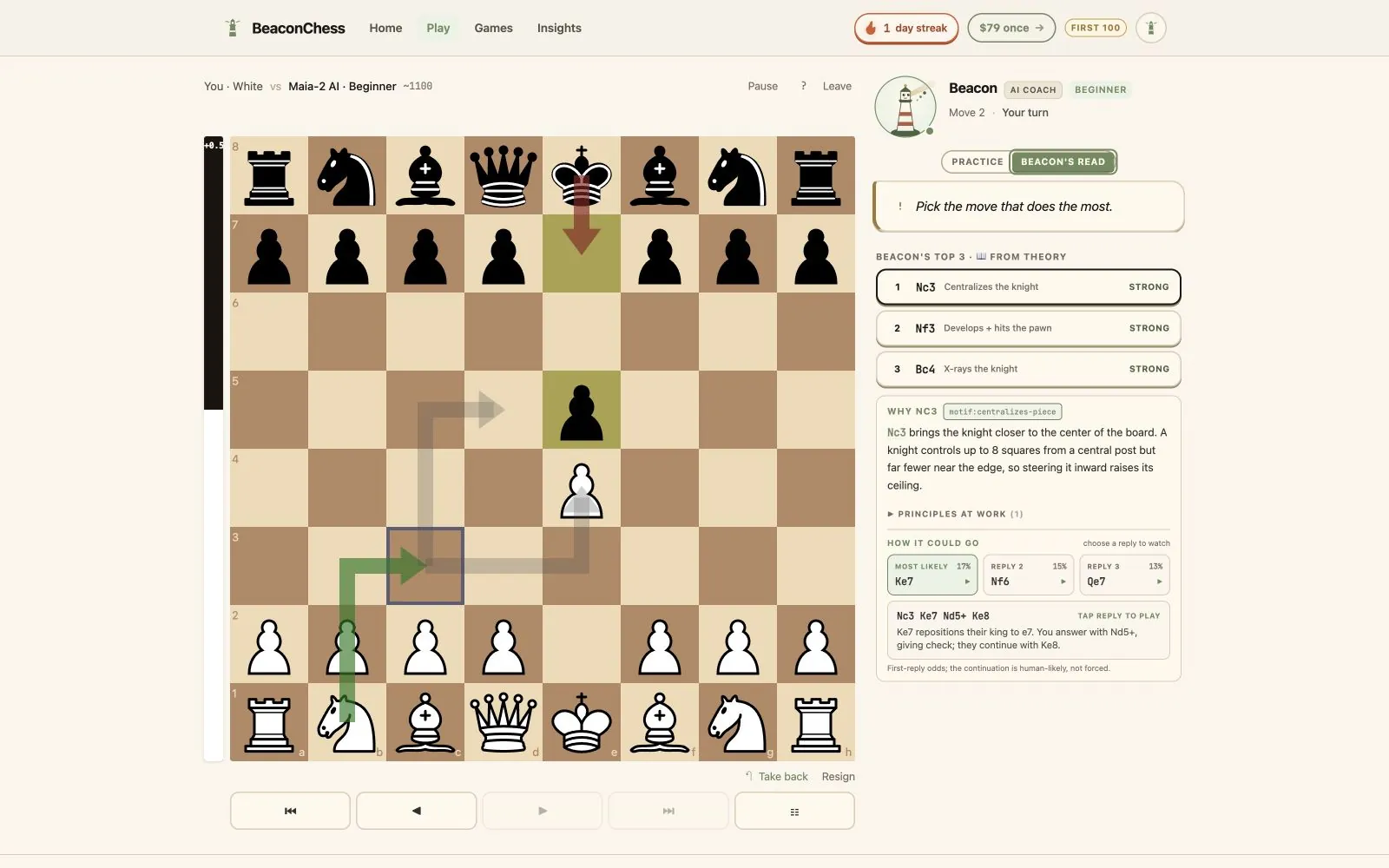
A score such as +1.2 says that the engine prefers White under its search and evaluation model. It does not automatically mean White is one pawn ahead, that the position is easy, or that a human can reproduce the line. The number becomes useful when it directs you back to the board.
Read the sign first
Positive favors White, negative favors Black, and mate values replace ordinary scores when a forced checkmate is found.
Study the change
The movement from one score to the next is often more instructive than the absolute number.
Return to the board
Ask which tactic, weakness, defender, or plan makes the evaluation different after the move.
On this page
What +1.0 and -2.3 actually mean
Traditional engine displays express evaluation in pawns or centipawns: 100 centipawns equals one pawn unit. The sign is usually from White's point of view, so +1.0 favors White and -1.0 favors Black. Some interfaces instead show the score from the side to move; check the interface before comparing values.
The unit is not a material receipt. Position, king safety, initiative, pawn structure, and long-term piece activity all influence the score. Modern Stockfish also normalizes its evaluation so the scale relates to expected winning chances in Stockfish self-play. That makes “one pawn” a convenient unit, not a claim that a pawn is physically missing.
Mate scores are a different kind of statement
A display such as M3 means the engine has found a forced mate within its convention for counting moves. It is not merely a very large positional advantage. The defending side may have several legal replies, but none avoids mate against the engine's calculated continuation.
Mate scores can change as search deepens, especially in composed positions or long forced sequences. If a lesson depends on a distant mate, verify the line at sufficient depth and focus on the first forcing idea a player could realistically recognize.
Why evaluation swings matter
Suppose the position is roughly equal before your move and clearly worse afterward. The swing tells you that the move changed something important. It does not yet say whether the cause was a hanging piece, a tactical sequence, a bad exchange, or a strategic concession.
Compare the played move with one or two alternatives and inspect the opponent's reply. If every reasonable reply keeps the score stable except one forcing move, the missed forcing move is the lesson. If the score drifts because your pieces become passive over several moves, the lesson may be a plan rather than a tactic.
Depth, time, and multiple good moves
An engine score is the result of a particular search. More time and depth can reveal tactics that were initially invisible or reorder close candidate moves. A shallow browser analysis is useful for triage, but it is not a proof that every quiet position has been solved.
Positions often contain several moves with nearly equal evaluations. Treat a tiny difference as a preference, not a moral grade. For learning, the move whose purpose you understand and can execute may be more useful to study than a narrow engine edge that depends on a difficult sequence.
How to turn a number into a lesson
First state the score change in plain terms: equal became worse, winning became unclear, or a forced mate appeared. Next name the opponent's critical reply. Finally, connect that reply to a visible fact on the board.
A complete explanation sounds like: “After the pawn push, the bishop can take the knight because its only defender is pinned.” The evaluation confirms the consequence, while the sentence supplies the pattern you can notice again.
Common questions
Clear answers before you try it.
Does +1 mean White is a pawn ahead?
Not necessarily. The score uses pawn units, but it includes positional factors and modern Stockfish normalization. Material may be equal while White has the more favorable position.
Why does an engine evaluation change at higher depth?
A deeper search can uncover a tactical resource, improve the estimated continuation, or reorder close moves. Large changes deserve verification; tiny changes often reflect nearby alternatives.
Is a move bad whenever the evaluation drops?
A drop is evidence that the engine prefers the previous position, but context matters. Look at the size of the change, the search depth, the available alternatives, and whether a concrete reply explains it.
What does M3 mean in chess analysis?
It means the engine has found a forced checkmate in its displayed count. The exact counting convention can vary by interface, so follow the line to see the sequence.
See the reason beside the score.
Paste a PGN or play a free coached game to connect evaluation changes with candidate moves, likely replies, and board-specific explanations.