3 min read
Chess coaching for beginners
Make the board feel less like chaos.
“Think a few moves ahead” skips the hardest part: deciding where to look. BeaconChess helps beginners turn a crowded board into a short routine. Notice what changed, check immediate threats, choose two or three sensible moves, and imagine the opponent’s most natural reply.
Reduce the noise
The coach focuses on hanging pieces, missed tactics, king danger, and other concrete turning points.
See the idea move
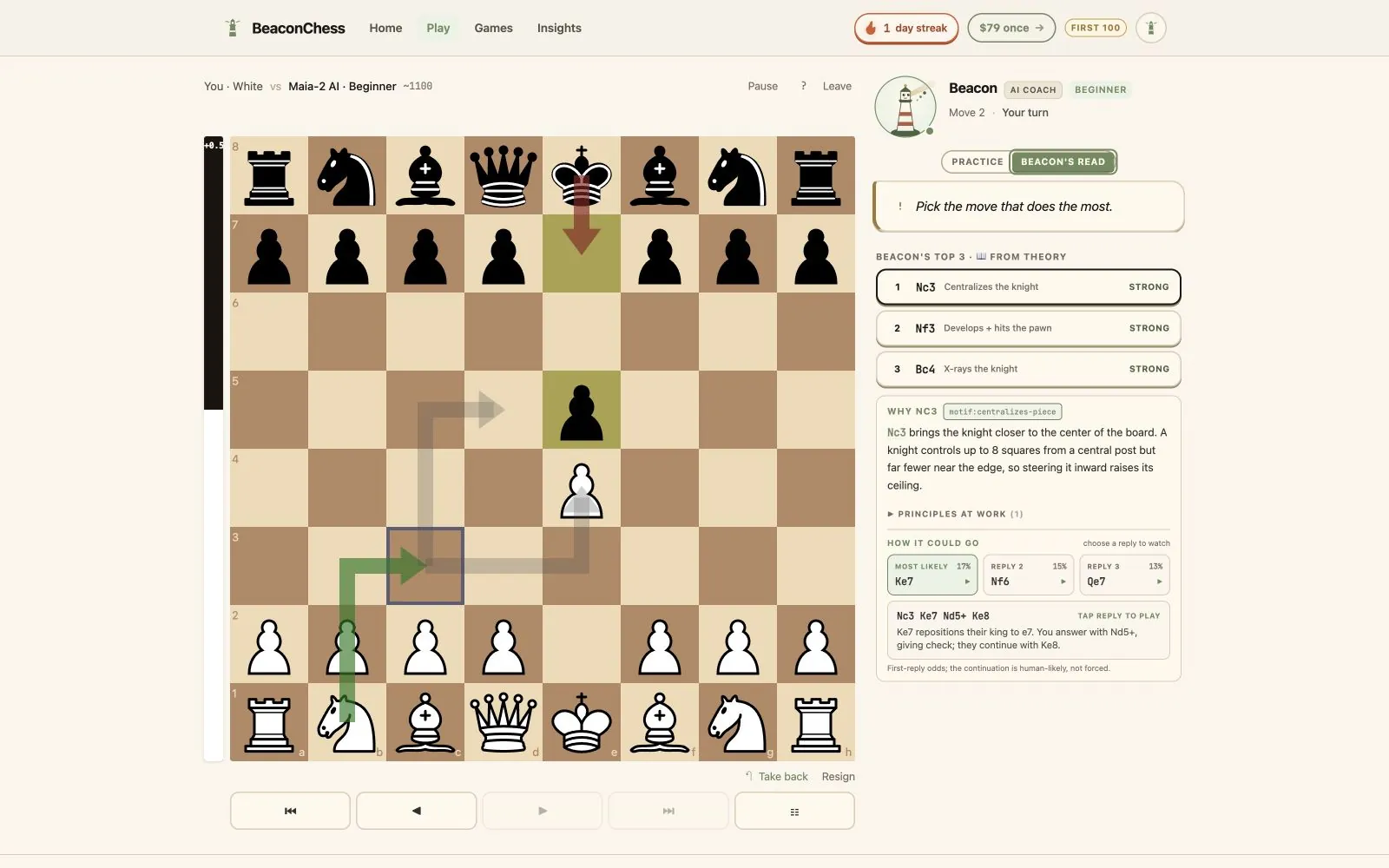
Arrows and playable lines show the idea on the board instead of asking you to visualize everything at once.
Try the full loop free
The first game uses the ~1100 Beginner Maia-2 level and includes live feedback plus the post-game recap.
On this page
Why “calculate deeper” is usually the wrong first instruction
Calculation starts after you choose moves to calculate. A beginner who tries to examine every legal move quickly gets overwhelmed. A better habit is to create a small candidate list: forcing moves, moves that solve an immediate problem, and moves that improve the least useful piece.
Beacon makes that invisible step visible. Candidate arrows narrow the board, while the explanation says what each move is trying to accomplish. You can hide the arrows later when you want to test the habit unaided.
A beginner-friendly thought process
You do not need to see ten moves ahead. Start by checking the position in the same order every time. A repeatable two-ply thought process is more useful than occasional five-move guesses.
- 1. What changed?After the opponent moves, notice which lines opened, which piece moved away, and what is now attacked.
- 2. What is forcing?Look at checks, captures, and direct threats for both sides before choosing a quiet move.
- 3. Which two or three moves make sense?Build a candidate list, then imagine the opponent’s most natural reply to each one.
- 4. What would be left hanging?Before moving, scan the destination square and the piece or pawn you are leaving behind.
Feedback that does not interrupt every move
Constant praise and constant warnings both become noise. Beacon is designed to speak when there is a useful chess idea: a blunder, hanging piece, missed tactic, important plan, or notable change in the position.
When a mistake is missed by the opponent, the recap can show the punishment that was available. That is often the most useful beginner lesson because it reveals a pattern before a stronger opponent exposes it over the board.
How to turn one game into one lesson
Do not try to repair the entire game. Pick the first moment where the position changed sharply. Play the candidate lines, explain the idea in your own words, and name one signal you will look for next time.
A useful lesson sounds like “when my knight moved, the rook behind it became loose,” not “I was minus 2.3.” The first sentence can change a future decision. The number only describes what already happened.
Common questions
Clear answers before you try it.
Do I need a chess rating to use BeaconChess?
No. If you know how the pieces move and can finish a game, the Beginner level is a reasonable starting point.
Will BeaconChess play perfectly against a beginner?
No. The opponent is powered by Maia-2, which predicts human moves at different rating conditions. It is designed to make more human-shaped choices than a full-strength engine with random errors.
Can the candidate arrows be turned off?
Yes. Candidate arrows are a teaching aid and can be switched off in Settings when you want to solve the position without hints.
Play one complete coached game for free.
No BeaconChess account, email, card, or installation is needed. Start with the ~1100 Beginner opponent.