3 min read
Chess training for club players
Turn engine lines into decisions you can repeat.
Club players can usually read an evaluation bar. The harder question is why a move entered the candidate list, which reply was underestimated, and how that mistake should change the next serious game. BeaconChess keeps the review centered on those decisions instead of turning every session into an engine research project.
Audit the candidate list
See which human-plausible moves entered the shortlist, then compare them with the moves you considered during the game.
Test practical replies
Compare several plausible first responses instead of reading one principal variation as if it were forced.
Name the real gap
Separate missed candidates from calculation errors and evaluation errors so the review leads to a specific training task.
On this page
The gap between analysis and over-the-board thinking
An engine can produce a deep line after the game, but tournament improvement depends on the decisions available before the clock runs out. Which candidates did you miss? Which reply did you underestimate? Was the idea tactical, positional, or simply a loose piece?
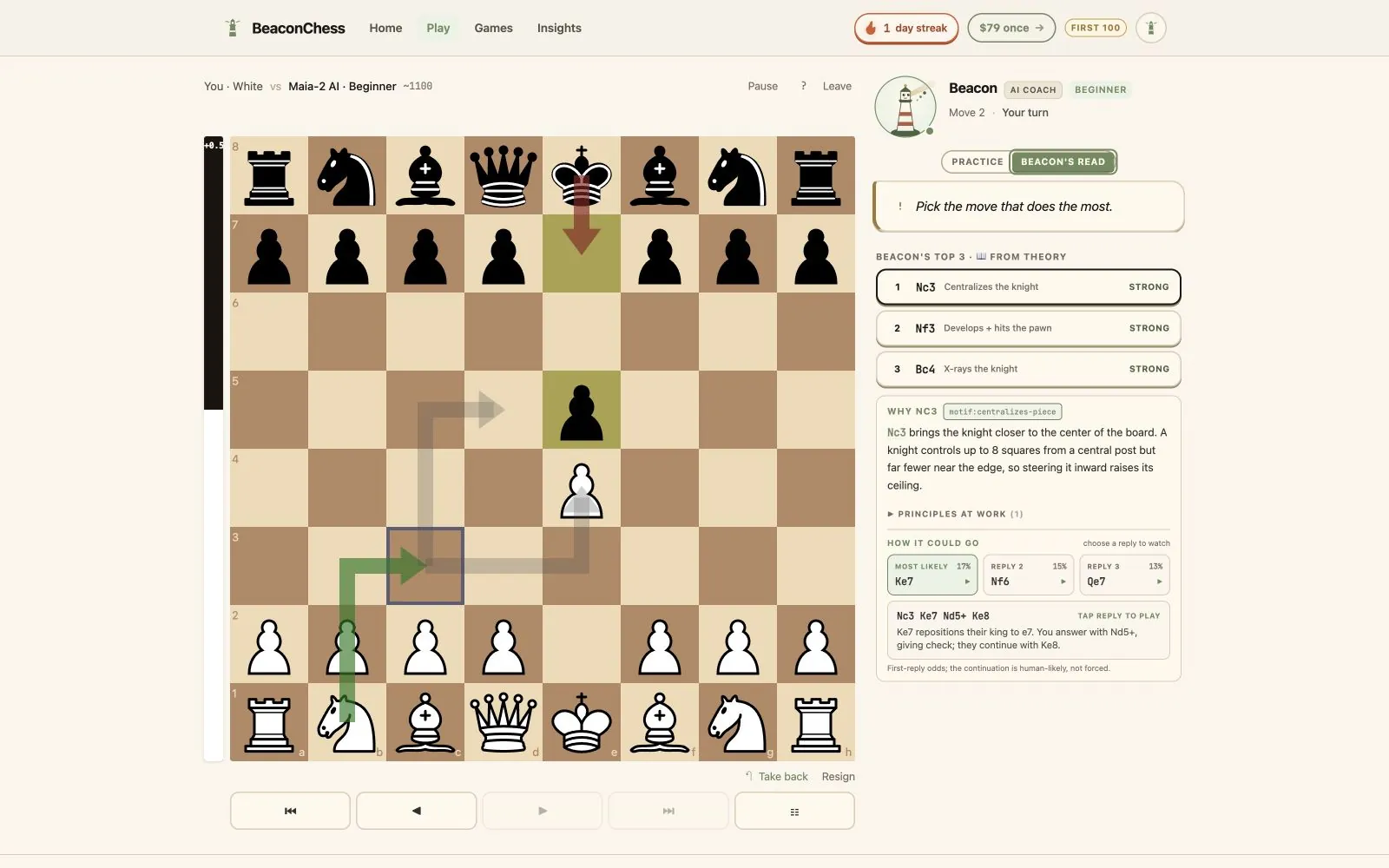
Beacon keeps those questions close to the board. It surfaces a manageable candidate set, attaches a concise reason to each move, and allows branches to be played visually. The aim is to rehearse the selection process, not imitate engine depth.
A review loop for serious improvers
Use the first pass without an engine. Mark the moments where you felt uncertain and write down the candidates you considered. Then open the game in BeaconChess and compare your list with its practical candidates. The difference between the lists is often more instructive than the evaluation swing.
- Candidate gapIf the best practical move never entered your list, study the board signal that should have generated it.
- Calculation gapIf the move was on your list but rejected, play the likely replies and find the branch you evaluated incorrectly.
- Evaluation gapIf the line was calculated correctly but judged badly, name the lasting factor: king safety, activity, structure, or material.
Train against choices that look human
A weakened traditional engine can feel artificial because perfect moves are mixed with arbitrary mistakes. Maia-2 is trained to predict moves humans at different ratings are likely to choose. Beacon exposes ten labeled opponent levels from ~1100 to ~2000.
Those labels are training targets, not promises that every short game will produce an exact performance rating. Their value is stylistic: the opponent’s choices are conditioned on human play rather than created by injecting random blunders into Stockfish.
Use the explanation as a hypothesis
No automated coach is infallible. Treat each explanation as a concise hypothesis tied to an engine line and the current board. If a claim feels wrong, play the alternatives, inspect the line, and let the resulting positions decide.
That skepticism is part of good analysis. Improvement does not come from passively accepting an engine label. It comes from comparing your original thought process with concrete variations and stating why your evaluation changed.
Common questions
Clear answers before you try it.
What rating range is BeaconChess for?
The opponent selector is labeled from ~1100 to ~2000. The explanation tools can still be useful outside that range, but the product is primarily designed for improving beginners and club players.
Can tournament games be imported?
Yes. Export or create a PGN and paste it into BeaconChess. Imported games receive the same analysis-board workflow.
Does BeaconChess replace working with a human coach?
No. A human coach can understand goals, psychology, tournament context, and long-term training needs. BeaconChess is a lower-cost, always-available study tool for game review and practice.
Review the decision, not only the evaluation.
Paste one PGN or play a coached game and compare the candidates you considered with the moves Beacon surfaces.